


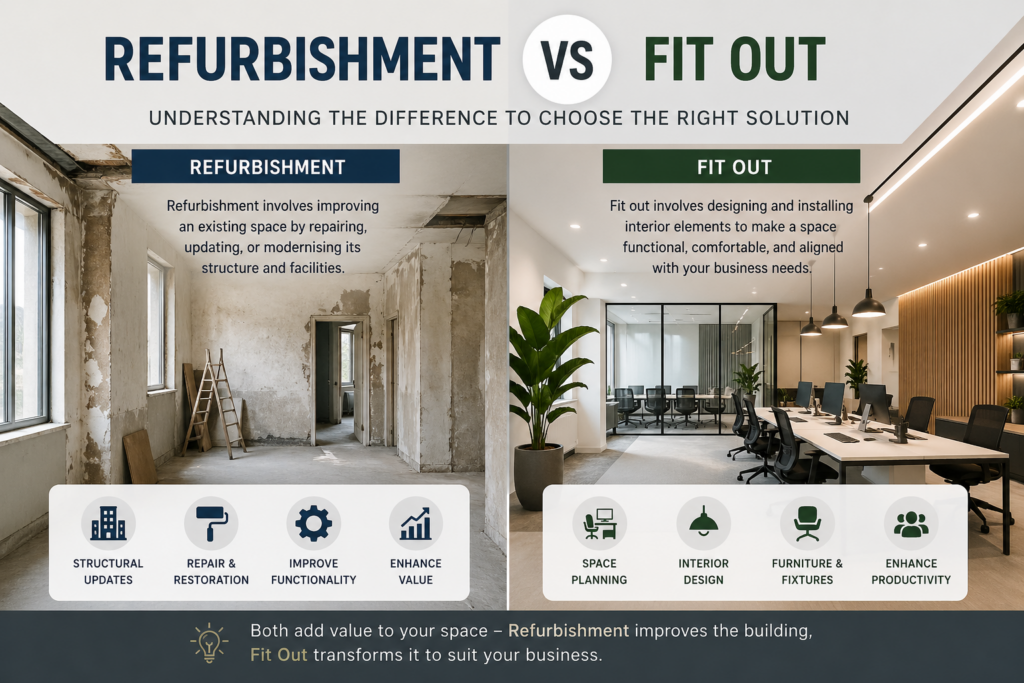
Choosing between a commercial refurbishment and a commercial fit out is one of the first decisions businesses make when upgrading their workspace. While the terms are often used interchangeably, they refer to different types of projects and are suited to different starting points.
A commercial refurbishment focuses on improving or modernising an existing space, whereas a commercial fit out transforms an empty or unfinished unit into a fully functional workplace. Understanding the distinction can help you plan your budget, minimise disruption, and ensure your project aligns with your operational goals.
This guide explains the key differences between refurbishment and fit out, explores where each approach is most suitable, and helps you determine the best option for your commercial property.
What’s the Difference Between Refurbishment and Fitout?
At a high level, refurbishment focuses on improving or upgrading an existing space. Fitout involves turning an empty or shell space into a usable environment.
| Aspect | Refurbishment | Fit Out |
| Starting Point | Existing occupied building | Empty shell or newly leased unit |
| Primary Goal | Upgrade, repair or modernise | Create a fully functional workspace |
| Scope | Interior upgrades, repairs, system improvements | Full interior construction, MEP installation, finishes and furniture |
| Space Planning | Existing layout usually retained with improvements | Complete layout design and optimisation |
| Mechanical & Electrical (MEP) | Existing services upgraded where required | New building services installed |
| Disruption | Often completed in phases | Usually completed before occupation |
| Budget | Generally lower investment | Higher initial investment |
| Timeline | Typically shorter | Usually longer |
| Best For | Existing offices, retail units or industrial premises | New commercial units or shell & core spaces |
Why Does the Difference Matter?
Choosing the right approach affects far more than the construction work itself. Your decision influences project costs, business disruption, regulatory requirements, and how effectively the finished space supports your operations.
A refurbishment is often the most practical solution when your existing premises remain structurally suitable but require upgrades to improve appearance, efficiency, or compliance.
A fit out is generally the better option when moving into a new commercial property or converting an empty unit into a fully operational workspace. Although it typically involves a higher upfront investment, it provides complete flexibility over layout, branding, and functionality.
Understanding these differences early helps businesses make informed investment decisions and avoid unnecessary project costs.
What are the Different Types of Commercial Fit Out?
Not every commercial fit out begins at the same stage. Depending on the condition of the building, fit out projects generally fall into one of three categories.
Shell & Core: A shell and core building includes the basic structural elements but has no internal finishes, services, ceilings, flooring, lighting or partitioning. The tenant is responsible for completing the interior.
Category A Fit Out: A Category A fit out prepares a commercial unit for occupation by installing essential building services such as suspended ceilings, lighting, raised floors, HVAC, fire protection systems and finished walls. The space is functional but not customised.
Category B Fit Out: A Category B fit out transforms the workspace into a finished office tailored to the occupier. This includes meeting rooms, glass partitions, kitchens, breakout areas, branding, furniture, flooring and specialist spaces designed around business operations.
View More: Commercial Fit Out
Common Types of Commercial Refurbishment
Commercial refurbishment projects vary depending on the building type and business objectives.
Typical refurbishment projects include:
- Office refurbishment to modernise existing workplaces.
- Retail refurbishment to improve customer experience.
- Hospitality refurbishment for hotels, restaurants and leisure venues.
- Healthcare refurbishment for clinics, laboratories and medical facilities.
- Industrial refurbishment to upgrade warehouses and manufacturing environments.
Unlike a fit out, refurbishment focuses on improving an existing space while retaining much of the original structure.
View More: Commercial Refurbishment
How Does This Apply Across Different Industries?
The choice between refurbishment and fitout varies depending on how each industry operates, its compliance requirements, and how the space is used day-to-day.
| Industry | When Refurbishment is Used | When Fitout is Used |
| IT & Tech Companies | Upgrading agile workspaces, improving collaboration zones, refreshing interiors | Setting up new offices, hybrid work environments, or expansion spaces |
| Banks & Financial Institutions | Modernising branches, improving customer experience, compliance upgrades | Creating new branches, head offices, or secure banking environments |
| Hospitality & Hotels | Renovating guest areas, updating interiors, maintaining brand standards | Developing new hotel spaces, restaurants, or front-of-house areas |
| Corporate Offices | Reconfiguring layouts, improving productivity, upgrading finishes | Creating new office environments from shell spaces |
| Leisure & Entertainment | Refreshing gyms, studios, or entertainment venues, updating branding | Building new facilities such as gyms, cinemas, or activity centres |
| Healthcare & Medical | Improving patient flow, upgrading compliance, modernising clinics | Setting up new clinics, dental practices, or medical facilities |
| Educational Facilities | Updating classrooms, improving layouts, upgrading infrastructure | Developing new teaching spaces, labs, or training environments |
| Industrial & Manufacturing | Optimising workflows, upgrading systems, improving safety standards | Creating new operational spaces, storage areas, or production units |
Can a Commercial Project Include Both Refurbishment and Fit Out?
Many commercial projects combine refurbishment and fit out rather than using one approach exclusively.
For example, a business relocating to a larger office may refurbish part of the existing building while fitting out newly acquired space. Similarly, warehouse developments often involve refurbishing office areas while fitting out new staff facilities or production zones.
Combining both approaches enables businesses to maximise existing assets while creating spaces that support future growth.
How to Choose Between Refurbishment and Fit Out
1. Assess Your Starting Point: If you’re working with an existing office or commercial premises, refurbishment may be the most practical solution. If you’re moving into an empty shell or newly leased unit, a fit out is usually required.
2. Define Your Objectives: Consider whether your goal is to modernise an existing workspace or create an entirely new environment designed around your team’s needs.
3. Consider Budget and Timescales: Refurbishment projects are often quicker and less expensive, while fit outs require greater investment but provide complete design flexibility.
4. Plan for Business Continuity: Businesses operating during construction often choose phased refurbishments to minimise disruption. New fit outs are generally completed before occupation.
5. Think About Future Growth: If expansion or changing workplace requirements are expected, incorporating flexible layouts during the project can reduce future refurbishment costs.
Where Do Design and Planning Fit into Both Approaches?
Both refurbishment and fitout benefit from early-stage planning.
A design-led approach helps:
- Avoid costly rework.
- Improve space efficiency.
- Align layout with operational needs.
This is why many projects integrate design and build services, even for refurbishment ensuring both strategy and execution are aligned. Before committing to either route, it’s worth assessing:
- Structural condition of the building.
- Capacity of existing services (power, HVAC).
- Compliance with current regulations.
- Long-term business plans.
Whether you’re planning a refurbishment or a fit out, engaging your design and build team early allows potential challenges to be identified before construction begins. Early planning improves cost certainty, ensures compliance with UK Building Regulations, and helps create a space that supports long-term operational requirements.
Final Thoughts
Choosing between refurbishment and fit out depends on the condition of your property, your business objectives, and how the space will be used.
Commercial refurbishment is ideal when an existing building requires upgrades, improved functionality or a refreshed appearance without completely rebuilding the interior. A commercial fit out is the right solution when transforming an empty commercial unit into a fully operational workplace.
Many commercial projects successfully combine both approaches, allowing businesses to modernise existing areas while creating new spaces designed for future growth. Understanding the differences early helps control costs, reduce disruption and ensure your commercial property supports your long-term business goals.
FAQs
Can a project involve both refurbishment and fitout?
Yes. Many commercial projects combine both. For example, refurbishing existing areas while fitting out newly acquired space within the same building.
Is planning permission required for refurbishment or fitout?
Not always. Minor works may not require approval, but structural changes, external alterations, or change of use typically do.
Which option adds more long-term value to a property?
Refurbishment can increase asset value by improving condition and efficiency, while fitout adds value by making the space usable and market-ready.
How do I minimise risk during refurbishment works?
Phased planning, clear scope definition, and working with experienced contractors help reduce operational disruption and unexpected costs.
Can a Commercial Project Include Both Refurbishment and Fit Out?
Many commercial projects combine refurbishment and fit out rather than using one approach exclusively.
For example, a business relocating to a larger office may refurbish part of the existing building while fitting out newly acquired space. Similarly, warehouse developments often involve refurbishing office areas while fitting out new staff facilities or production zones.
Combining both approaches enables businesses to maximise existing assets while creating spaces that support future growth.E
What is the biggest mistake businesses make when choosing between the two?
Assuming refurbishment will always be cheaper. If existing infrastructure is outdated, a fitout may actually be more cost-effective long-term.

